Note
Go to the end to download the full example code.
Create grid masks from spatial shapes
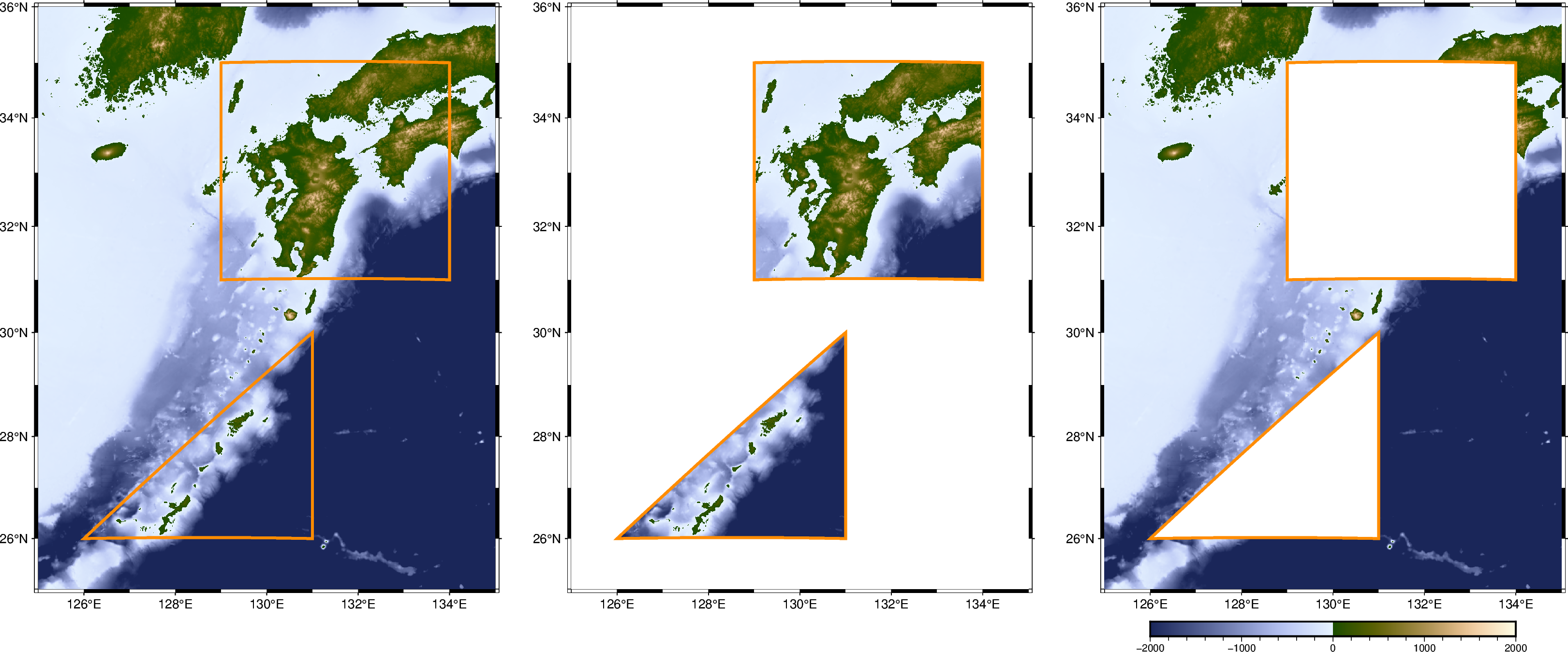
The functionn pygmt.grdmask allows to create a grid mask based on spatial
shapes given as closed polygons. These polygons can be provided as NumPy arrays or
GeoPandas DataFrame. For the nodes falling inside, outside, and on the edges, different
values can be defined. The create mask can then be applied to a desired grid.
To create a land-water mask based on the GMT built-in shoreline data you can directly
use the function pygmt.grdlandmask explained in the gallery example
:doc:` Create ‘wet-dry’ mask grid </gallery/images/gradlandmask>`.
import geopandas
import numpy as np
import pygmt
from shapely.geometry import Point
Polygons based on NumPy arrays
# Define a study region
region = [125, 135, 25, 36]

# Define two closed polygons, here a square and a triangle.
# Use an np.nan to separate the polygons
polygon = np.array(
    [
        [129, 31],
        [134, 31],
        [134, 35],
        [129, 35],
        [129, 31],
        [np.nan, np.nan],
        [126, 26],
        [131, 26],
        [131, 30],
        [126, 26],
    ],
)

# Download elevation grid
grid = pygmt.datasets.load_earth_relief(region=region, resolution="30s")

# Create a grid mask based on the two polygons defined above
# Set all grid nodes outside the polygons to NaN
mask_out = pygmt.grdmask(region=region, data=polygon, spacing="30s", outside="NaN")
# Set all grid nodes inside the polygons to NaN
# Set the outside parameter to a value larger 0 to keep the nodes outside unchanged
mask_in = pygmt.grdmask(
    region=region, data=polygon, spacing="30s", inside="NaN", outside=1
)

# Apply the grid mask to the downloaded elevation grid by multiplying the two grids
grid_mask_out = grid * mask_out
grid_mask_in = grid * mask_in


fig = pygmt.Figure()
pygmt.makecpt(cmap="SCM/oleron", series=[-2000, 2000])

# Plot the elevation grid
fig.basemap(region=region, projection="M12c", frame=True)
fig.grdimage(grid=grid, cmap=True)
fig.plot(data=polygon, pen="2p,darkorange")

fig.shift_origin(xshift="+w+2c")

# Plot the masked elevation grid outside
fig.basemap(region=region, projection="M12c", frame=True)
fig.grdimage(grid=grid_mask_out, cmap=True)
fig.plot(data=polygon, pen="2p,darkorange")

fig.shift_origin(xshift="+w+2c")

# Plot the masked elevation grid inside
fig.basemap(region=region, projection="M12c", frame=True)
fig.grdimage(grid=grid_mask_in, cmap=True)
fig.plot(data=polygon, pen="2p,darkorange")

fig.colorbar(frame=True)
fig.show()
grdblend [NOTICE]: Remote data courtesy of GMT data server oceania [http://oceania.generic-mapping-tools.org]
grdblend [NOTICE]: SRTM15 Earth Relief v2.7 at 30x30 arc seconds reduced by Gaussian Cartesian filtering (2.6 km fullwidth) [Tozer et al., 2019].
grdblend [NOTICE]:   -> Download 15x15 degree grid tile (earth_relief_30s_g): N15E120
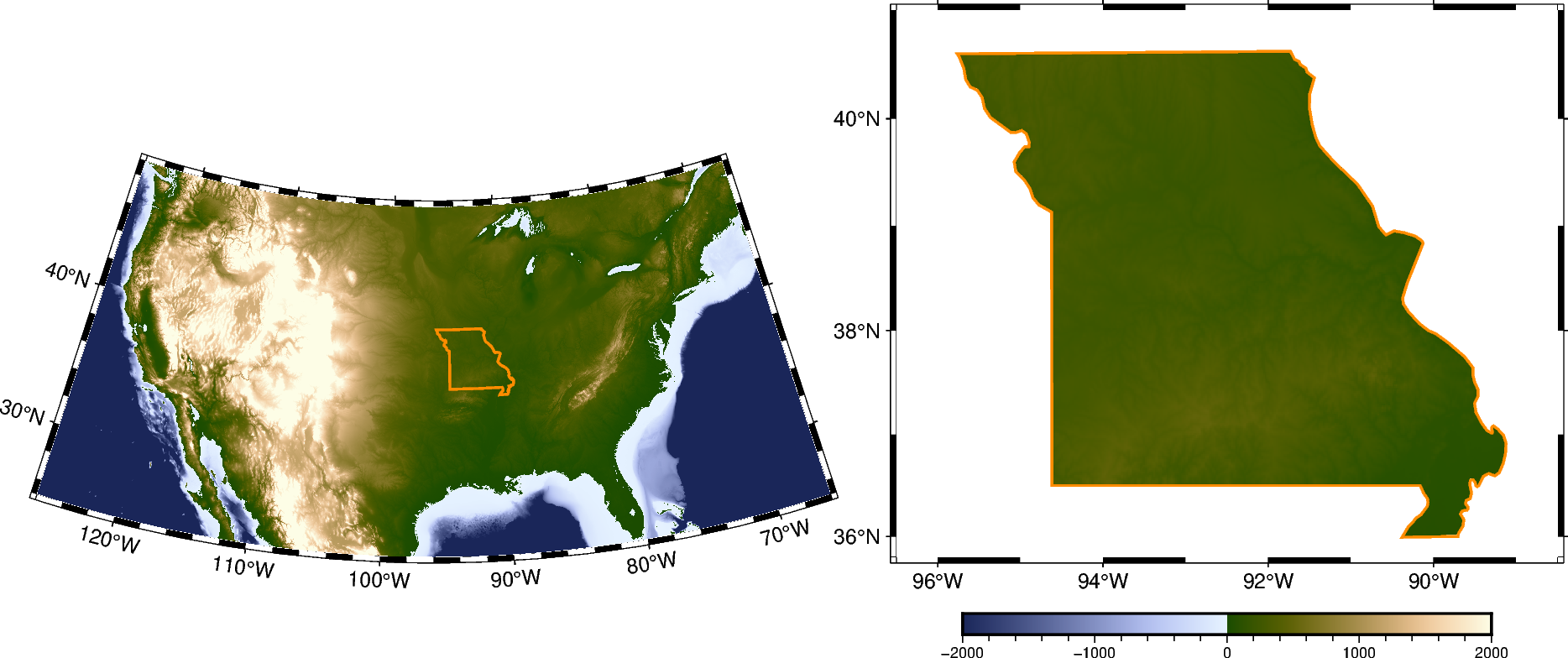
US state Missouri based on GeoPandas polygon geometry
region = [-126, -66, 25, 49]

provider = "https://naciscdn.org/naturalearth"
states = geopandas.read_file(
    f"{provider}/50m/cultural/ne_50m_admin_1_states_provinces.zip"
)
missouri = states[states["name"] == "Missouri"]

grid = pygmt.datasets.load_earth_relief(region=region, resolution="01m")
mask = pygmt.grdmask(region=region, data=missouri, spacing="01m", outside="NaN")
mask_lonlat = mask.rename(new_name_or_name_dict={"x": "lon", "y": "lat"})
grid_mask = grid * mask_lonlat


fig = pygmt.Figure()
pygmt.makecpt(cmap="SCM/oleron", series=[-2000, 2000])

# Plot the elevation grid
fig.basemap(projection="L-96/35/33/41/12c", region=region, frame=True)
fig.grdimage(grid=grid, cmap=True)
fig.plot(data=missouri, pen="1p,darkorange")

fig.shift_origin(xshift="+w+1c")

# Plot the masked elevation grid
# fig.basemap(projection="L-96/35/33/41/12c", region=region, frame=True)
fig.basemap(projection="M10c", region=[-96.5, -88.5, 35.8, 41], frame=True)
fig.grdimage(grid=grid_mask, cmap=True)
fig.plot(data=missouri, pen="1p,darkorange")

fig.colorbar(frame=True)
fig.show()
grdblend [NOTICE]: Remote data courtesy of GMT data server oceania [http://oceania.generic-mapping-tools.org]
grdblend [NOTICE]: SRTM15 Earth Relief v2.7 at 01x01 arc minutes reduced by Gaussian Cartesian filtering (5.2 km fullwidth) [Tozer et al., 2019].
grdblend [NOTICE]:   -> Download 30x30 degree grid tile (earth_relief_01m_g): N00W150
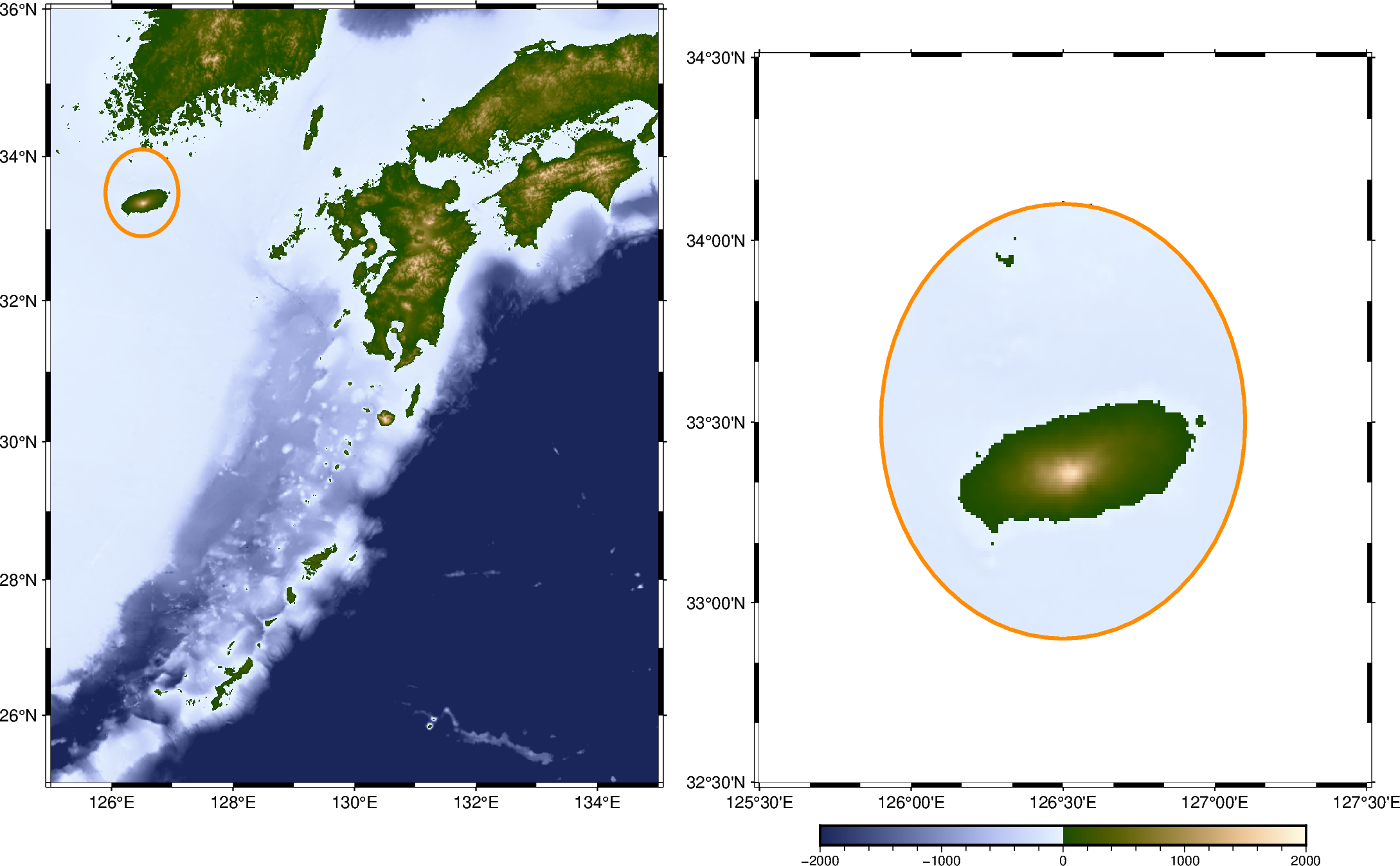
Circle based on GeoPandas polygon geometry
region = [125, 135, 25, 36]

# Create a point and buffer it
point = geopandas.GeoSeries([Point(126.5, 33.5)])
circle = point.buffer(0.6)  # 10 is the radius

grid = pygmt.datasets.load_earth_relief(region=region, resolution="30s")
mask = pygmt.grdmask(region=region, data=circle, spacing="30s", outside="NaN")
mask_lonlat = mask.rename(new_name_or_name_dict={"x": "lon", "y": "lat"})
grid_mask = grid * mask_lonlat


fig = pygmt.Figure()
pygmt.makecpt(cmap="SCM/oleron", series=[-2000, 2000])

# Plot the elevation grid
fig.basemap(region=region, projection="M12c", frame=True)
fig.grdimage(grid=grid, cmap=True)
fig.plot(data=circle, pen="2p,darkorange")

fig.shift_origin(xshift="+w+2c")

# Plot the masked elevation grid
fig.basemap(region=[125.5, 127.5, 32.5, 34.5], projection="M12c", frame=True)
fig.grdimage(grid=grid_mask, cmap=True)
fig.plot(data=circle, pen="2p,darkorange")

fig.colorbar(frame=True)
fig.show()
Total running time of the script: (0 minutes 31.054 seconds)